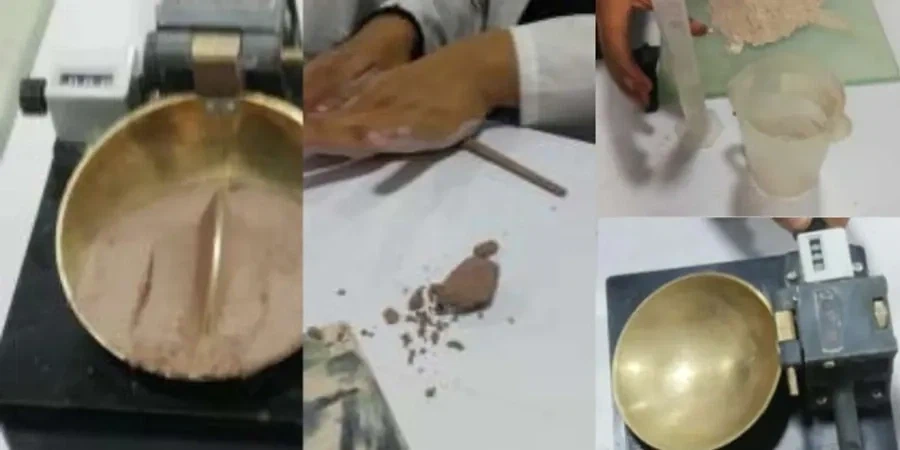
The most frequent call we get from Bognor Regis contractors is the one where the ground has turned to slurry after a week of rain. West Sussex has a maritime climate, and Bognor’s coastal plain sits on a mix of Brickearth, London Clay outcrops and Quaternary drift deposits. Skip the Atterberg limits on a cohesive soil here and you are guessing the shrink-swell potential. We run the full suite—liquid limit using the Casagrande percussion cup method, plastic limit by thread-rolling, and the derived plasticity index—under BS 1377-2:1990. The numbers feed directly into bearing capacity calculations and foundation design per Eurocode 7. For sites near the Aldingbourne Rife, where groundwater is high, we often pair this with a test pit investigation to verify the stratigraphy before sampling, and the grain size analysis to complete the soil classification picture.
A plasticity index above 25% on London Clay in Bognor Regis means you need a 1.5 m deep foundation—no shortcuts.
Site-specific factors
The Casagrande cup device sits on a solid workbench in our lab, set to a calibrated 10 mm drop height. The technician mixes the soil paste to a uniform consistency, fills the brass cup, cuts a standard groove with the ASTM grooving tool, and counts the blows. The risk when skipping this test in Bognor Regis is real: a PI misjudged by 5% on a clay foundation can reduce the allowable bearing pressure by 30–50 kPa, enough to turn a compliant footing into a settlement failure. On the A29 corridor near Shripney, we have seen clays with a PI of 38%—class CH, highly plastic—that required redesign of the entire foundation scheme halfway through construction. The clay fraction in these soils drives volume change with seasonal moisture fluctuation. Without the Atterberg numbers, the shrink-swell classification in NHBC Chapter 4.2 cannot be completed, and the building control sign-off stalls.
Quick answers
What is the typical cost of Atterberg limits testing in Bognor Regis?
For a standard Atterberg limits test covering liquid limit, plastic limit and plasticity index, the cost ranges from £50 to £80 per sample depending on the number of samples submitted and the turnaround time required.
How many soil samples are needed for a representative Atterberg test?
We recommend at least one disturbed sample per distinct soil horizon encountered in the borehole or test pit. For a typical two-storey house foundation in Bognor Regis, that usually means 2 to 3 samples taken from depths between 0.5 m and 2.0 m, depending on the stratigraphy.
How long does the Atterberg limits test take to complete?
Standard turnaround is 3 working days from sample receipt. We also offer a 24-hour express service for urgent projects. The test itself requires careful moisture conditioning and multiple determinations, so rushing the natural drying stage compromises accuracy.
Which soils require Atterberg limits testing?
Any fine-grained soil with more than 35% passing the 425 µm sieve should be tested. In Bognor Regis, this applies to the London Clay, Brickearth and alluvial silts found across the coastal plain. Granular soils with low fines content typically skip Atterberg and go straight to particle size distribution.