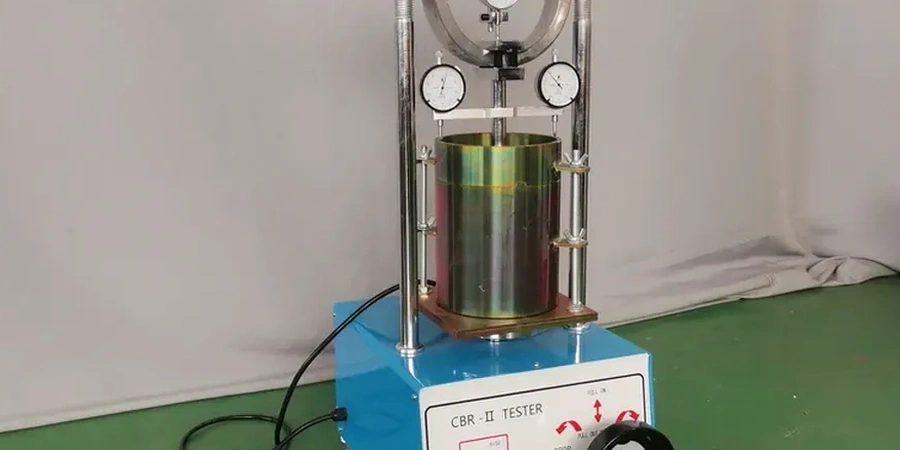
We still see design submissions for Bognor Regis residential roads where the CBR value is assumed rather than measured, and that assumption usually proves costly when the subgrade turns out to be a wet, silty brickearth typical of the West Sussex coastal plain. The town sits on a mix of Quaternary brickearth over Cretaceous chalk, and the near-surface soils can lose significant bearing capacity once saturated. A laboratory CBR test run to BS 1377-4 gives the design team a defensible number, whether soaked for winter groundwater conditions or unsoaked for summer construction windows. Before committing to a pavement thickness, many local engineers combine this with a Proctor test to verify compaction targets, and a grain-size analysis to flag frost-susceptible fines that would otherwise degrade the subbase over time.
A CBR value of 2% versus 5% in West Sussex brickearth can mean the difference between 300 mm and 180 mm of Type 1 subbase — that is real cost sitting in the pavement design.
Site-specific factors
The CBR press in our Bognor Regis laboratory is a 50 kN motorised frame with a calibrated load cell and a 49.6 mm diameter plunger, running penetration at a steady 1.27 mm per minute. The biggest risk we see is not the machine itself but the sample conditioning: a poorly sealed curing bag or a soak tank with fluctuating water temperature introduces bias that no amount of data correction can fix. If the swell reading wanders overnight because the dial gauge stem got nudged, the entire soaked CBR curve shifts and the designer ends up with a number that does not represent the in-situ subgrade. West Sussex County Council adopt rigorous checking of CBR values for Section 278 agreements, and a single outlier in the dataset can trigger a full re-test at the contractor's expense. We log temperature, soak duration, and surcharge mass on every worksheet so the chain of custody is traceable back to the trial pit location.
Quick answers
How much does a laboratory CBR test cost in Bognor Regis?
A single-point soaked CBR test to BS 1377-4 typically ranges from £110 to £160, depending on whether it is part of a larger testing suite. Three-point compaction for a full curve costs more because of the extra moulds and soak time. We can provide a firm quote once we know the number of samples and whether you need soaked, unsoaked, or both.
Do I always need a soaked CBR for a Bognor Regis pavement design?
Almost always, yes. West Sussex County Council generally requires the soaked CBR value for adoption roads because the local brickearth and chalk subgrades are moisture-sensitive. An unsoaked test can be useful during construction for temporary haul roads, but the design submission nearly always calls for the four-day soaked figure.
How do you compact the sample before testing?
We use either the 2.5 kg rammer for standard Proctor effort or the 4.5 kg rammer for modified effort, depending on the specification. For a full CBR curve we compact three moulds at different moisture contents spanning optimum, so the designer can read CBR at any target density.
What is the swell percentage and why does it matter?
Swell is the vertical expansion of the specimen during soaking, measured by a dial gauge on top of the surcharge plate. In Bognor Regis brickearth, swell values above 2% are common and they flag a subgrade that will heave in wet winters. If swell is high, the pavement design may need a capping layer or a thicker subbase to isolate the formation.
Can you test chalk subgrade from a Bognor Regis site?
Yes, but chalk requires careful handling. We follow SHW Clause 612 guidance: the material is broken down to pass a 20 mm sieve without crushing individual chalk lumps, and we often pair CBR with MCV testing because chalk can give misleadingly high CBR values if tested dry. Soaking with a low surcharge weight simulates the near-surface condition more realistically.