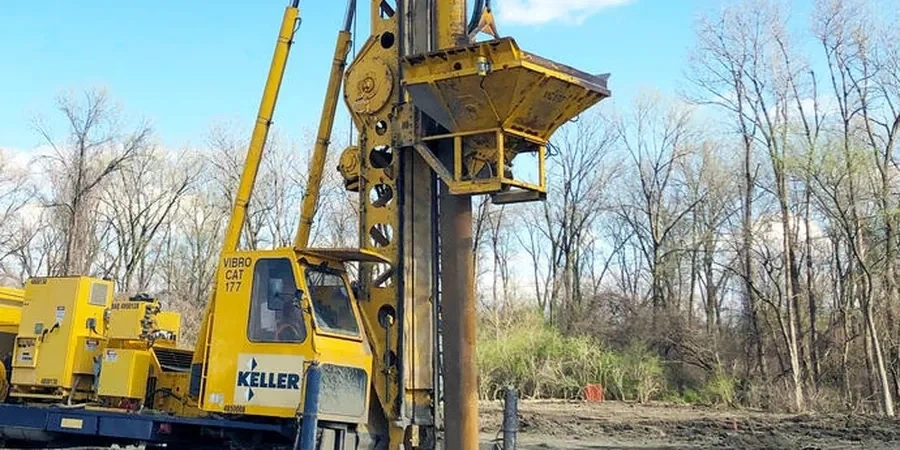
A depth vibrator isn't a subtle piece of kit. It's a long, heavy, cylindrical probe with internal eccentric weights, hung from a crawler crane that rumbles across the site, sending powerful horizontal vibrations into the ground as it sinks under its own weight and compressed air or water flushing. In Bognor Regis, where so much of the buildable land sits on loose marine sands and the Quaternary gravels of the old coastal plain, this machine is often the difference between a viable foundation and an expensive over-design. We see it regularly on sites near the coast, where the natural granular deposits just lack the density needed for anything heavier than a two-storey house. Before the vibrator ever touches the ground, though, the design phase has to answer a series of critical questions: what target density, at what depth, on what grid spacing, and with what backfill material. That's where our laboratory and field team comes in, combining site-specific CPT testing to profile the loose zones and laboratory grain size analysis to confirm the gradation is suitable for densification, because not every sand responds the same way to vibration.
Vibrocompaction works by temporarily liquefying the soil mass—grains rearrange, voids collapse, and the ground surface can drop 200 to 500 millimetres in a single pass.
Site-specific factors
Bognor Regis grew outward from its 18th-century seaside resort core, and much of the later housing expansion pushed onto the flat-lying coastal plain where the natural ground was never meant to carry concentrated structural loads. The main risk isn't total collapse; it's differential settlement that cracks brickwork, misaligns door frames, and pulls service connections apart over the first five years of a building's life. A vibrocompaction design that looks perfect on paper can still underperform if the ground conditions change laterally across the site—and they often do here, with lenses of silt or organic clay interrupting the sand sequence. That's why our design process includes a mandatory geological desk study before any vibrator mobilises. We cross-reference historical borehole records from the British Geological Survey with our own intrusive investigation to flag any soft pockets that need a different treatment approach, because running a depth vibrator into a clay lens just remoulds the clay without any useful compaction effect. The cost of skipping this step shows up later as localised depressions in floor slabs or tilted foundations, and retrofitting Improvement under an occupied building is an order of magnitude more expensive than getting the design right the first time.
Quick answers
How much does a vibrocompaction design package cost for a residential plot in Bognor Regis?
For a typical residential plot in Bognor Regis requiring ground investigation, laboratory testing, design report, and on-site compaction monitoring, the cost generally falls between £1,270 and £4,300 depending on the treated area, depth of loose material, and number of verification tests required. A site with a simple sand profile and a single building footprint sits at the lower end; a larger plot with variable ground, multiple treatment zones, and extensive post-compaction CPT verification moves toward the upper range.
What soil types are suitable for vibrocompaction?
Vibrocompaction works on granular soils—clean sands and gravels with a fines content below about 15% passing the 63-micron sieve. The grain size distribution matters a lot; if there's too much silt or clay, the vibration transmits poorly and the soil remoulds rather than densifying. In Bognor Regis, the marine sands and coastal gravels are generally ideal candidates, but we always run a full particle size distribution test first to confirm suitability across the treatment depth.
How long does the vibrocompaction process take on site?
A typical residential plot in Bognor Regis with 50 to 80 compaction points can be treated in two to three days once the rig is mobilised. The trial phase and design work happen beforehand, usually over one to two weeks including the laboratory testing. Post-treatment verification adds another day on site plus reporting time. The whole package from instruction to final report typically runs three to five weeks.
Can vibrocompaction be used near existing buildings in Bognor Regis?
It depends on the proximity and the building condition. Depth vibrators generate significant ground-borne vibration, and within 5 to 8 metres of a sensitive structure we'd usually switch to a different Improvement method or install vibration monitoring with trigger limits. For typical detached housing with a reasonable standoff distance, vibrocompaction is routinely carried out without issues, but we always include a pre-condition survey of neighbouring properties as standard practice on urban or suburban sites in Bognor Regis.