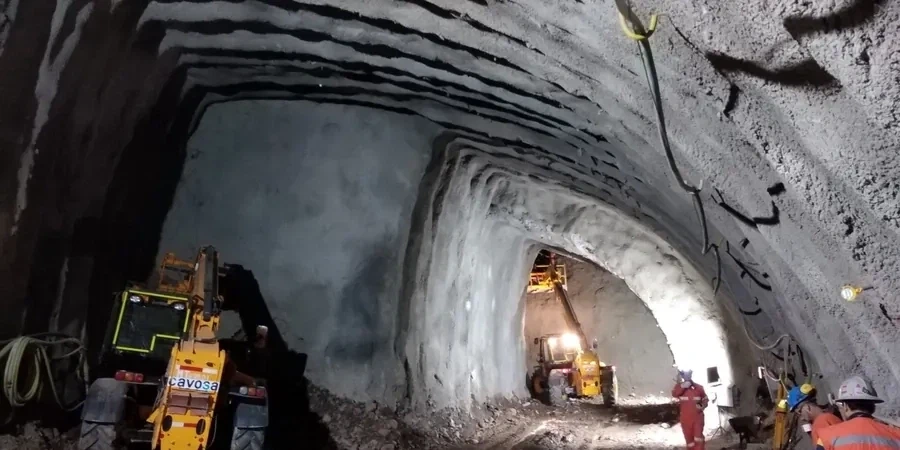
BS EN 1997-2 is the starting point for any tunnel investigation, but in Bognor Regis the application has to be sharper. The town sits on the West Sussex Coastal Plain, where the bedrock of the London Clay Formation is overlain by thick sequences of Quaternary brickearth and alluvium. These are soft, often normally consolidated soils that demand a geotechnical analysis tailored to their behaviour under excavation. Our team has worked on schemes where the groundwater table, just a metre or two below street level, turned a standard drive into a high-risk operation. Before any TBM or cut-and-cover work begins in Bognor Regis, we combine In-Situ with laboratory programmes that map the transition between the superficial deposits and the more competent clays beneath. For preliminary assessments, a CPT test provides a rapid, continuous profile of the soft strata without disturbing the sample, while targeted SPT drilling confirms strength parameters at the tunnel horizon.
In Bognor Regis, the real tunnel challenge isn't the London Clay at depth — it's the soft, saturated alluvium capping it. Get the analysis right there, and the rest follows.
Site-specific factors
Bognor Regis expanded rapidly in the late 19th and early 20th centuries, with much of the development concentrated on the flat, low-lying ground between the railway and the sea. This is exactly the zone where the softest alluvial deposits are found. We have reviewed site investigation records from projects near the town centre where historical watercourses, now culverted, left pockets of organic silt and peat. Tunnel construction through these materials without a proper geotechnical analysis invites immediate problems: uncontrolled face loss, excessive settlement at the surface, and in the worst case, a collapse that propagates upwards. The Victorian terraces and seafront structures in Bognor Regis are particularly sensitive to differential movement. Our analysis quantifies the settlement risk using empirical methods and finite element modelling, so that the ground support system can be designed to limit volume loss to well under 2%. That is the difference between a drive that goes unnoticed at street level and one that makes headlines.
Quick answers
What is the typical cost range for a soft soil tunnel geotechnical analysis in Bognor Regis?
For a project in Bognor Regis, the geotechnical analysis for soft soil tunnels typically falls between £3,560 and £13,820. The final cost depends on the length of the alignment, the number of boreholes or CPT soundings required, and the complexity of the laboratory testing programme. A short pedestrian tunnel will be at the lower end, while a longer road or utility tunnel with extensive triaxial testing and numerical modelling will be at the higher end.
How do you deal with the high groundwater table in Bognor Regis during tunnel investigation?
High groundwater is a defining feature of the Bognor Regis coastal plain. We install standpipe and vibrating wire piezometers during the ground investigation to monitor pore water pressures at multiple depths. In the laboratory, we run consolidated undrained triaxial tests with pore pressure measurement to define the effective stress parameters. This data allows the tunnel designer to calculate the required face support pressure and to design a dewatering or exclusion system if needed.
Which parameters are most critical for tunnel design in the brickearth found in Bognor Regis?
For the brickearth in Bognor Regis, the critical parameters are the undrained shear strength and the stiffness at very small strain, because this soil is often structured and sensitive. We measure these through a combination of in-situ SPT N-values, CPT cone resistance, and laboratory triaxial tests with local strain measurement. The liquidity index is also important, as much of the brickearth in Bognor Regis has a natural water content close to the liquid limit, which makes it prone to remoulding during tunnel excavation.
How long does a full geotechnical analysis take for a tunnel project?
A full geotechnical analysis for a tunnel project in Bognor Regis typically takes 6 to 10 weeks from the start of fieldwork to the delivery of the final interpretive report. Fieldwork including drilling and In-Situ takes 1 to 3 weeks. The laboratory testing programme, particularly the triaxial and oedometer tests on the soft alluvium and brickearth, requires 4 to 6 weeks for consolidation and shearing stages. The final week is dedicated to numerical analysis and reporting.