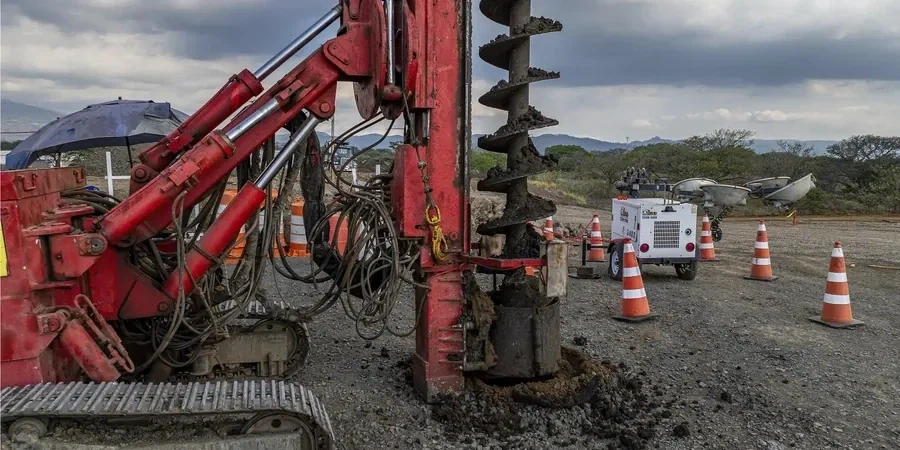
The coastal plain beneath Bognor Regis conceals a sequence of soft alluvial clays and loose marine sands that extend well below the water table, often to depths where conventional shallow foundations become uneconomical. With the town sitting just above sea level and the chalk aquifer exerting influence on pore pressures, any medium to heavy structure needs a Improvement strategy that addresses both bearing capacity and long-term settlement. We apply vibro-replacement stone column design following BS EN 1997-1:2004, calibrated with site-specific cone penetration data to account for the undrained shear strength profiles typical of the West Sussex coast. Where the made ground overlying the Brickearth is thicker than expected, which happens frequently near the town centre redevelopments, the column spacing and diameter must be tightened to keep differential settlement within tolerable limits. Our laboratory in the region holds UKAS accreditation to ISO 17025 for the triaxial and classification tests that feed directly into the design parameters, so the final column layout reflects the actual variability of the Bognor Regis subsurface rather than generic textbook assumptions.
When the Bognor Regis subsoil reveals less than 30 kPa undrained shear strength, well-designed stone columns routinely halve the predicted settlement compared to an untreated raft.
Site-specific factors
Bognor Regis grew from a small fishing hamlet into a seaside resort during the Victorian period, and much of the seafront and town-centre development rests on nineteenth-century fill that was placed without any engineered compaction. That historical fill, combined with the natural soft alluvium of the Aldingbourne catchment, creates a two-layer problem: the upper stratum is loose and heterogeneous, while the lower clay is normally consolidated and highly compressible. Skipping a proper ground investigation and designing stone columns on assumed parameters leads to either under-treatment, where differential settlement cracks appear in partition walls within the first five years, or over-treatment that wastes tens of thousands of pounds on unnecessary column metres. A further risk specific to the Bognor Regis foreshore is the tidal fluctuation of the water table, which can induce fines migration into the stone column if the filter design is not matched to the particle-size distribution of the host soil. We mitigate that with a graded filter envelope or a geotextile wrap proved by laboratory compatibility testing, ensuring the drainage path remains open for the design life of the structure.
Quick answers
What ground conditions in Bognor Regis make stone columns the right choice?
Stone columns work well in the soft silty clays and loose sands found across the Bognor Regis coastal plain, particularly where the undrained shear strength is between 15 and 50 kPa. They are less suitable if a dense gravel layer or a thick peat horizon is present within the treatment depth, which is why we always run a CPT or borehole investigation before committing to the method.
How much does a stone column design package cost for a typical Bognor Regis project?
For a Bognor Regis site the design package, including the interpretative report and calculation pack, falls between £1,190 and £4,460 depending on the size of the treatment area and the complexity of the ground profile. We provide a fixed-price proposal once we have reviewed the preliminary ground investigation data.
Do you handle the installation as well as the design?
Our primary role is the geotechnical design and verification. We can recommend experienced vibroflot contractors who work regularly on the south coast, and we stay involved during installation to carry out the post-treatment testing and sign off the compliance report.
How do you verify that the stone columns are performing as designed?
We run CPT soundings at pre-agreed locations between the columns to measure the increase in tip resistance and sleeve friction. For larger Bognor Regis schemes we also specify zone load tests on isolated columns, comparing the load-settlement curve with the design prediction to confirm the settlement reduction factor is being achieved.
Can stone columns be designed beneath existing buildings in Bognor Regis?
Yes, but it requires careful planning. For low-headroom situations or structures with sensitive finishes, we adapt the design to use smaller rigs or a bottom-feed system, and we specify tighter vibration-monitoring limits. A detailed condition survey of the existing building is essential before any treatment begins.