← Home · Slopes & Walls

Active and Passive Anchor Design in Bognor Regis: Ground Stabilisation for Coastal Formations

Together, we solve the challenges of tomorrow.

SEE MORE →

Applying BS EN 1997-1:2004 and BS 8081 in Bognor Regis requires a granular understanding of how the local stratigraphy—specifically the Lambeth Group and Bracklesham Beds—interacts with tensile forces. The town’s position on a low-lying coastal plain, with the English Channel just over half a mile from the town centre at certain points, means groundwater conditions fluctuate significantly between winter saturation and summer drawdown. We design anchor systems that account for these seasonal pore-water pressure shifts, ensuring that both temporary and permanent installations maintain load capacity without excessive creep. For projects where the weathered London Clay transitions into sandy silts, we often combine anchor testing with an in-situ permeability test to verify drainage assumptions before finalising the bond length calculations.

Anchor design in coastal towns like Bognor Regis isn't just about pull-out capacity—it's about selecting a corrosion protection class that survives forty years of saline groundwater attack.

Approach and scope

With a resident population exceeding 63,000 and a growing demand for mixed-use developments along the A29 corridor, Bognor Regis is seeing deeper excavations for underground parking and coastal defence upgrades. A critical parameter here is the undrained shear strength of the cohesive layers, typically ranging between 60 and 120 kPa in the upper weathered zone. Our anchor design methodology differentiates between active anchors—where prestressing locks in the structural deformation—and passive anchors, which engage only when ground movement occurs. The choice between a strand anchor with a double corrosion protection system and a simpler bar anchor depends on the design life specified in BS 8081. In fractured zones of the Bognor Regis geological sequence, we specify pressure-meter testing to refine the grout-to-ground bond values, avoiding the conservative assumptions that inflate anchor lengths unnecessarily. When retaining structures require a composite approach, we integrate the anchor layout with retaining wall design to optimise the bending moments in the stem and reduce the required embedment depth.
Active and Passive Anchor Design in Bognor Regis: Ground Stabilisation for Coastal Formations
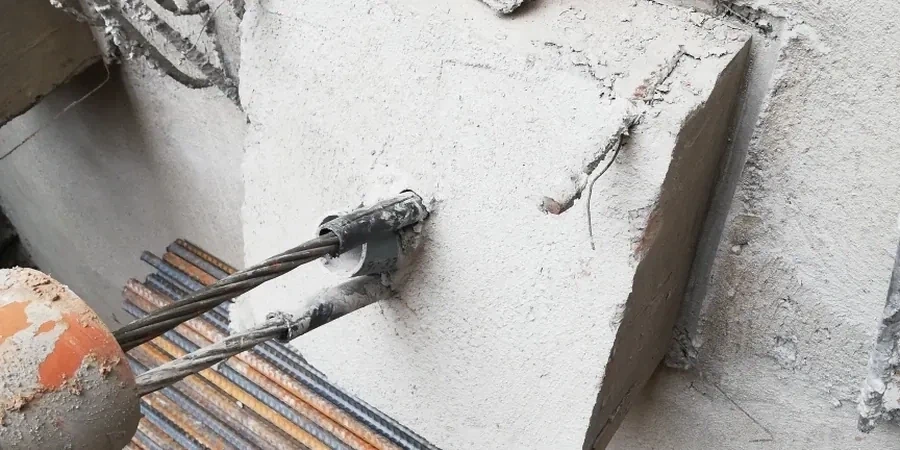
Technical reference image — Bognor Regis

Site-specific factors

Bognor Regis sits on Paleogene sedimentary formations where the Lambeth Group clays can contain lenses of sand running with artesian water. Hitting one of these lenses during borehole drilling for an anchor installation can trigger a sudden loss of annulus grout, compromising the bond zone. In passive anchor applications—such as soil nailing for temporary excavations in the town centre—the risk shifts to long-term corrosion if the sacrificial steel thickness is miscalculated for the moderately aggressive soil environment. We address this by specifying a minimum 4 mm sacrificial thickness on bar anchors and requiring full encapsulation with a factory-made corrugated sheath for permanent strand anchors. Another site-specific concern is the proximity of Victorian-era infrastructure near the seafront: old brick sewers and unrecorded foundations often require us to adjust anchor inclination angles and reduce installation pressure to avoid hydrofracturing the ground.

Need a geotechnical assessment?

Reply within 24h.

Email: contact@geotechnical-engineering1.com

Technical parameters


ParameterTypical value
Design standardBS EN 1997-1, BS 8081:2015
Anchor typeActive (prestressed) / Passive (deadman, soil nail)
Typical bond length in Bracklesham Beds4.0 m – 8.5 m
Tendon specificationDywidag bar or 7-wire strand (BS 5896)
Corrosion protection classClass I (permanent) / Class II (temporary)
Proof load test acceptance1.25 x working load (min 95% theoretical elastic extension)
Free length design> 5.0 m or beyond critical slip surface
Creep rate limit< 2 mm per log cycle of time during sustained load test

Related technical services

01

Prestressed Active Anchor Design

For retaining walls and basement slabs requiring immediate load transfer. We calculate the lock-off load, free length, and fixed anchor length using the cone method and local shear strength parameters. Each design includes a detailed stressing sequence and acceptance criteria per BS 8081.

02

Passive Anchor and Soil Nail Systems

For slope stabilisation and temporary excavations in the Bognor Regis area. We design self-drilling hollow bar anchors for collapsing ground conditions typical of the Wittering Formation, with pull-out capacity verified through on-site suitability testing.

Relevant standards


BS EN 1997-1:2004 (Eurocode 7: Geotechnical design), BS 8081:2015 (Code of practice for grouted anchors), BS EN 1537:2013 (Execution of special geotechnical works—Ground anchors)

Common questions

What is the typical cost range for an anchor design package in Bognor Regis?

For a standalone anchor design package covering a typical retaining wall or excavation support in Bognor Regis, the fee ranges from £820 for a straightforward temporary works design to £3,050 for a comprehensive permanent anchor scheme with corrosion protection Class I, finite element verification, and full construction-phase support. The final figure depends on the number of anchor rows, the complexity of the ground profile, and whether proof load testing supervision is included.

How do you determine whether an active or passive anchor system is more suitable for my site?

The decision hinges on allowable deformation. If the structure behind the anchor can tolerate virtually no movement—say, an existing building facade within Bognor Regis town centre—we specify an active anchor prestressed to 80–100% of the working load. Passive anchors are acceptable where some millimetres of displacement are permissible before the anchor engages, such as in temporary open-cut excavations or slope regrading projects. We assess the serviceability limit state and the proximity of sensitive structures to make the final recommendation.

What testing do you require to validate an anchor design?

BS 8081 mandates three types: suitability tests on sacrificial anchors before production drilling (up to 1.5 x working load), proof load tests on every production anchor (1.25 x working load), and a subset of extended creep tests where the load is held for up to 24 hours to confirm stable behaviour. In Bognor Regis, we typically recommend creep testing on at least 5% of permanent anchors due to the time-dependent deformation properties of the Lambeth Group clays.
Location and service area

We serve projects across Bognor Regis and its metropolitan area.

View larger map