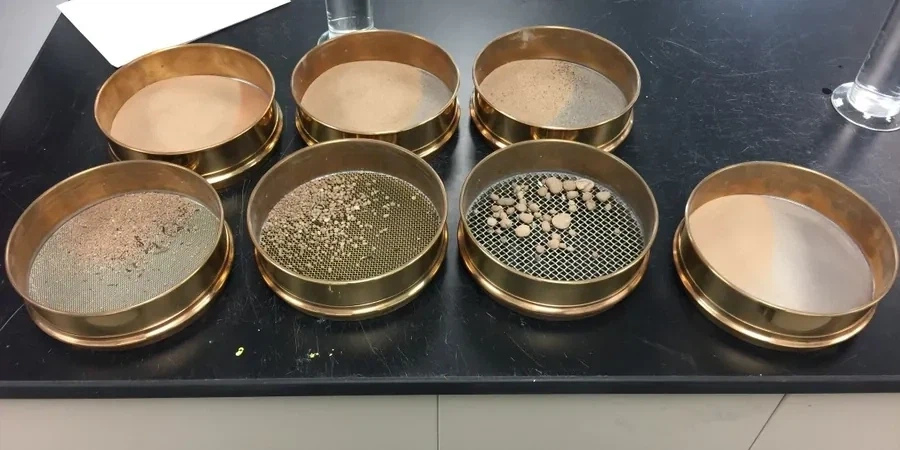
A recent coastal defence upgrade near Aldwick exposed a metre-thick lens of silty fine sand directly overlying London Clay Formation deposits. The contractor’s initial assumption of a uniformly graded beach sand fell apart the moment the first SPT drilling samples reached the lab. We ran a full sieve stack plus hydrometer series on twelve specimens from that borehole and found fines content exceeding 35 percent in three distinct strata. That finding changed the filter design criteria overnight. Bognor Regis sits on a complex Quaternary sequence where marine, fluvial and brickearth deposits interleave unpredictably. A simple sieve-only curve misses the silt and clay fraction that governs drainage, frost susceptibility and liquefaction potential under the cyclic loading conditions that coastal structures face twice daily with the tidal range here.
The hydrometer fraction below 63 microns is what separates a well-graded fill specification from a material that will trap pore water and fail prematurely in Bognor’s saturated winter ground conditions.
Quick answers
Why can’t we just use a sieve stack and skip the hydrometer for Bognor Regis sands?
Because many sands here contain 15–40 percent silt and clay that pass the 63 μm sieve. That fines fraction controls permeability, frost heave potential, and the soil’s behaviour under vibration. Without the hydrometer you miss the entire fine tail of the grading curve, which is exactly the part that governs drainage performance in Bognor’s high-water-table coastal zones.
How much sample do you need for a full sieve-plus-hydrometer analysis?
Ideally 1 kg of representative disturbed material in a sealed bag. For fine-grained soils we can work with 300 g. Samples must be preserved at natural moisture content until pretreatment; oven-dried samples received from site are rejected because the drying process alters the clay fraction’s dispersibility.
What does grain size analysis cost per sample in Bognor Regis?
A combined sieve-and-hydrometer test typically ranges from £70 to £140 per sample depending on whether organic pretreatment, salinity correction or additional Atterberg limits are required. We provide a fixed-price quotation once we know the number of samples and the expected fines content.
How long does the hydrometer sedimentation phase take to complete?
The full hydrometer reading sequence runs over 24 hours minimum, with readings at 0.5, 1, 2, 4, 8, 15, 30, 60, 120, 240 and 1440 minutes. Combined with the sieve stack work and reporting, a standard batch of six samples leaves the lab within three working days. Urgent turnaround for single samples can be arranged.