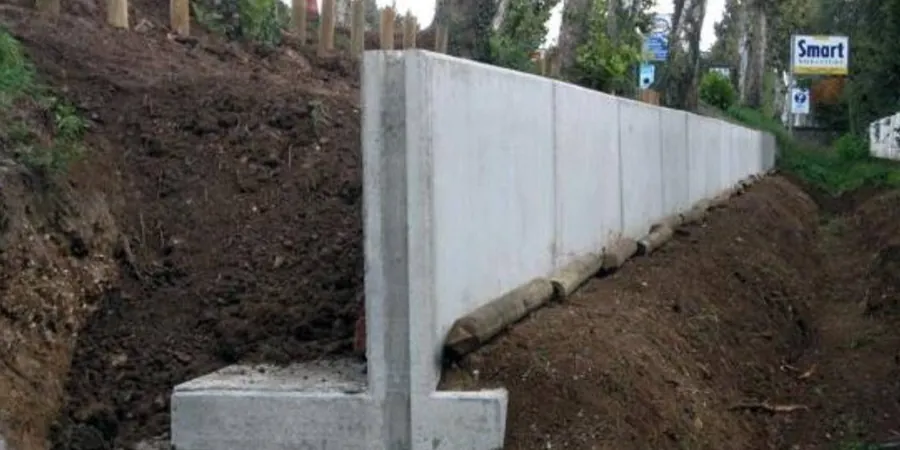
Bognor Regis sits just above sea level along the West Sussex coast, with large parts of the town barely reaching 5 metres elevation. This proximity to the English Channel shapes every excavation and retaining structure across the district. The local geology features Quaternary Brickearth overlying the Upper Chalk and patches of the London Clay Formation, creating a layered profile where retaining wall design must account for abrupt changes in stiffness and drainage within a few vertical metres. Whether a project involves a basement extension near the seafront or a terraced cut on a sloping residential plot north of the A259, the ground conditions demand a site-specific approach. Our team integrates test pit observations to map the shallow Brickearth-Chalk interface before selecting earth pressure parameters, and we routinely run in-situ permeability tests where perched water tables are suspected behind proposed walls.
Coastal Brickearth demands drainage-first design: a retaining wall without a properly graded filter and weep system in Bognor Regis can develop hydrostatic pressures that double the design load within a single wet season.
Site-specific factors
A tracked excavator fitted with a tilting bucket opens the trial pit on a residential plot off Chichester Road while the engineer logs the face, measuring the depth to the first chalk fragments and checking for seepage at the silt-chalk contact. That contact is the critical plane in this town: water travels laterally along the low-permeability chalk surface, saturating the base of the Brickearth and reducing effective stress exactly where the wall's heel or embedment relies on passive resistance. Getting the drainage detail wrong means the retaining wall design becomes a liability rather than an asset. We specify graded granular backfill, geotextile separators, and weep holes at 1.5-metre centres as a minimum, but also model the fully saturated case in the ultimate limit state check to ensure the structure survives a blocked drain scenario. Where the wall retains a public highway, we coordinate with West Sussex County Council for Section 278 agreements and ensure the design meets the Technical Approval requirements for highway-adjacent structures.
Quick answers
Do I need planning permission for a retaining wall in Bognor Regis?
Retaining walls over 1 metre high adjacent to a highway, or over 2 metres elsewhere, generally require planning permission under the Town and Country Planning Act. Walls below these thresholds may still need building regulations approval if they affect a structure. The Arun District Council planning portal provides the current guidance, and we prepare the necessary geotechnical design statements to support your application.
How much does retaining wall design cost for a typical residential project in Bognor Regis?
For a residential retaining wall in the Bognor Regis area, the design fee typically ranges from £830 to £3,570, depending on the retained height, the complexity of the ground conditions, and whether a full ground investigation with trial pits and lab testing is included. A simple gravity wall under 1.5 metres on proven chalk will fall toward the lower end; an embedded cantilever wall over 3 metres with Brickearth and a high groundwater table will require more analysis and sit at the upper end.
What is the biggest design risk for retaining walls on the West Sussex coastal plain?
Water pressure build-up behind the wall is the dominant risk. The Brickearth-Chalk contact acts as a natural drainage barrier, and without adequate weep holes and a free-draining backfill zone, hydrostatic pressure can quickly exceed the design assumptions. We always model the fully saturated condition and specify a filter layer that prevents silt migration into the drainage system — a detail that is often omitted in standard construction but is essential in Bognor Regis.
How long does the design and approval process take?
A typical programme runs four to six weeks from instruction to issue of the final design package. This includes the ground investigation, laboratory testing of soil and chalk samples, structural analysis, and preparation of the design report with drawings. If a party wall agreement is required or if the wall is near a public sewer, we allow additional time for utility searches and third-party approvals.