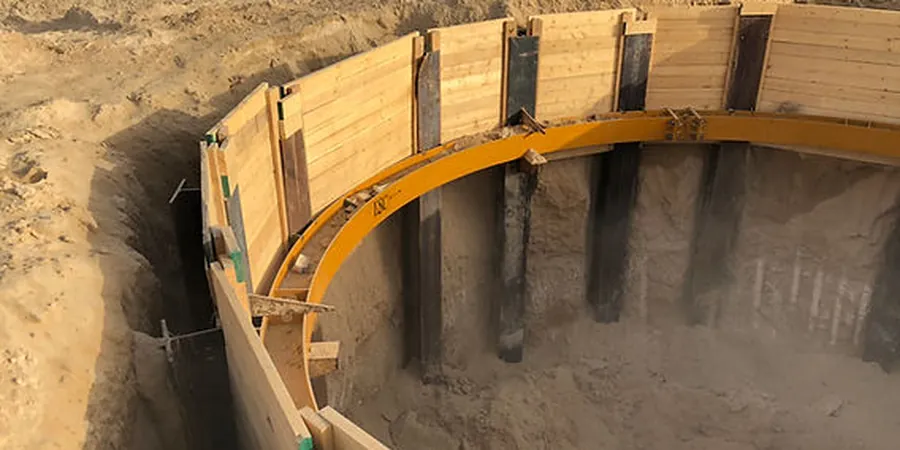
On Bognor Regis sites near the Aldwick or Felpham coastline, we repeatedly see the same issue: a few metres of soft Brickearth sitting directly over weathered Upper Chalk, with groundwater barely two metres down. That layered profile makes pile foundation design a careful exercise in shaft friction degradation and toe bearing verification, not a routine table lookup. The Chalk can carry serious end-bearing pressure, but only if you confirm the absence of dissolution features and soft putty zones below the pile tip. Our laboratory team processes the triaxial strength data and consolidation parameters that feed directly into the load-transfer curves, while the CPT test logs give us continuous sleeve friction and pore pressure profiles to calibrate the shaft resistance model in each strata.
Chalk isn't rock in the conventional sense — its load capacity in Bognor Regis depends on intact structure, not just UCS, and that structure can vanish within a metre laterally.
Regulatory framework
BS EN 1997-1:2004 (Eurocode 7: Geotechnical design — General rules), BS 8004:2015 (Code of practice for foundations), CIRIA C574 (Engineering in Chalk, 2002), ICE Specification for Piling and Embedded Retaining Walls (3rd edition, 2017), BS EN 1992-1-1:2004 (Eurocode 2: Design of concrete structures for pile reinforcement)
Quick answers
What ground investigation data is essential before pile foundation design in Bognor Regis?
As a minimum, you need rotary core drilling into the chalk with TCR/SCR/RQD logging per BS 5930, CPTu soundings to refusal, and laboratory classification on the Brickearth and chalk samples. We also recommend downhole geophysics or cross-hole seismic to detect dissolution features. Without this package, the CIRIA C574 chalk grade cannot be reliably assigned and the pile design remains speculative.
What is the typical cost range for pile foundation design on a Bognor Regis residential project?
For a single dwelling with four to six piles, the pile foundation design package typically falls between £1.170 and £5.500, depending on whether a full ground investigation report already exists or we need to specify and manage the site investigation from scratch. Complex sites with slope stability, party wall issues, or deep made ground push toward the upper end of that range.
How do you account for chalk dissolution features in the pile design?
We map the rockhead profile using a dense grid of probe holes or geophysics, then run a probabilistic assessment of the minimum competent chalk thickness beneath each pile toe. If solution pipes are detected, we either deepen the piles to bridge the feature or adopt a rafted pile group that can arch over a local void, depending on the structural tolerance to differential settlement.