← Home · Investigation

CPT Testing in Bognor Regis: Cone Penetration Profiling for Coastal Plain Soils

Together, we solve the challenges of tomorrow.

SEE MORE →

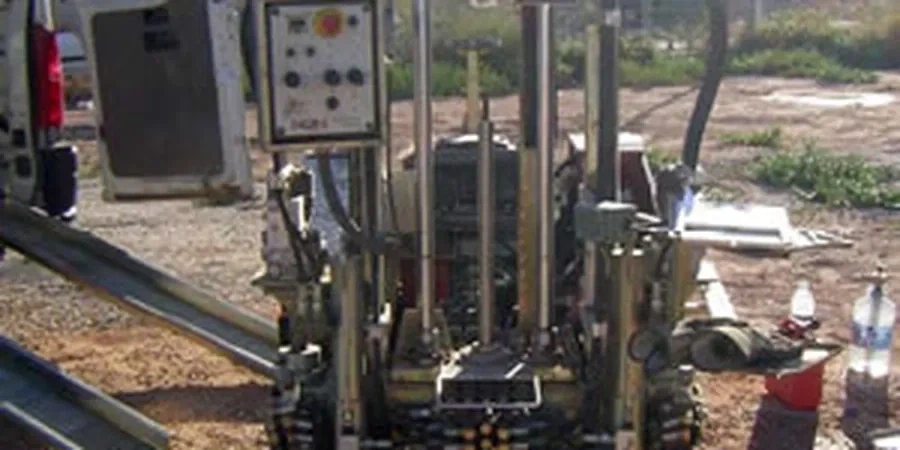
Our CPT rig is a 20-tonne tracked crawler fitted with a 100 kN hydraulic push system and a digital cone containing a 10 cm² tip load cell, a 150 cm² friction sleeve and a pore pressure transducer behind a saturated porous filter. When the rig sets up on a site in Bognor Regis, the first step is always levelling the thrust frame on timber crane mats because the natural ground across the coastal plain rarely offers a flat, stable platform. The cone is advanced at a constant 20 mm/s through the superficial deposits that characterise the town — a sequence of brickearth, marine sands of the raised beach complex, and the underlying Chichester Group clays. Each centimetre of penetration records cone resistance qc, sleeve friction fs, and dynamic pore pressure u2, which together build a near-continuous stratigraphic log without the sample disturbance that rotary drilling inevitably introduces. Before mobilising the CPT unit we often review existing test pit logs from earlier site investigations to anticipate obstructions in the weathered cap, and we cross-check CPT soil behaviour type against grain size curves from adjacent boreholes to calibrate the friction ratio classification for local lithologies.

A CPT dissipation test in the brickearth horizon tells you more about settlement rate in Bognor Regis than any laboratory consolidation test on a disturbed sample.

Approach and scope

Bognor Regis sits on a gently shelving coastal plain where the geological succession moves from Holocene alluvium in the Aldingbourne Rife corridor into Pleistocene raised beach deposits — the same cobbly sands and gravels mapped by the British Geological Survey as the Pagham Formation — and then into the stiff overconsolidated clays of the Eocene London Clay and Reading Formation at depth. Cone penetration testing reads this transition with remarkable clarity: the friction ratio drops below 1.5% in the clean sands of the raised beach, then climbs sharply above 4% as the sleeve friction dominates in the plastic clays. A key local challenge is the perched water table that sits within the brickearth horizon after winter recharge; the CPT pore pressure trace shows a positive u2 excursion at that interface, and we run dissipation tests by stopping penetration and recording the decay curve until u2 returns to hydrostatic — typically 3 to 15 minutes in silty fine sands. For sites near the seafront east of the pier, where saline intrusion affects pore fluid conductivity, we combine the CPT sounding with resistivity profiling to map the freshwater-saltwater interface before designing foundation depths. On projects requiring bearing capacity estimates directly from qc profiles, the data feeds into the Schmertmann method for shallow footings, while deeper schemes often need complementary SPT drilling to obtain disturbed samples for index testing of the clay layers that the cone can identify but not physically recover.
CPT Testing in Bognor Regis: Cone Penetration Profiling for Coastal Plain Soils
Technical reference image — Bognor Regis

Site-specific factors

The contrast between a dry August and a saturated February in Bognor Regis is enough to change the CPT profile by 20% in the upper three metres. When the brickearth is desiccated in summer, qc values can exceed 8 MPa and suggest a dense granular soil; after prolonged winter rain the same horizon reads below 4 MPa and classifies as a soft silt. Relying on a single CPT sounding without accounting for seasonal moisture variation leads to either overestimating bearing capacity in summer or underestimating settlement in winter. The raised beach deposits introduce a different risk: cobbles and flint nodules up to 150 mm diameter can deflect the cone or spike the tip resistance to the instrument limit, and without a pre-drilled starter hole through the gravelly cap the rod string can buckle. We always run a quick seismic refraction line before deep CPT programmes on the Pagham Formation to map the top-of-cobble surface, and we specify 55 mm diameter push rods with a thicker wall section when cobble refusal is anticipated. In the London Clay at depth, the low permeability means that excess pore pressure generated during cone advance dissipates slowly — ignoring that partially drained response when calculating undrained shear strength from net cone resistance produces unconservative values that can compromise foundation design on the heavier clay subgrades under Bognor's newer housing estates north of the A259.

Need a geotechnical assessment?

Reply within 24h.

Email: contact@geotechnical-engineering1.com

Service video


Technical parameters

ParameterTypical value
Cone tip resistance qc range0–100 MPa (standard 10 cm² cone)
Sleeve friction fs range0–1.6 MPa (150 cm² friction sleeve)
Pore pressure transducer capacity0–3.5 MPa (u2 position, behind cone shoulder)
Penetration rate20 mm/s ±5%, BS EN ISO 22476-1:2012
Maximum push depth in Bognor Regis soilsTypically 18–25 m (coastal plain deposits)
Friction ratio Rf classificationSands <1.5%, silts 1.5–4%, clays >4%
Dissipation test t50 range (brickearth)3–15 minutes (perched water table)
Data acquisition interval10 mm (continuous digital log)

Related technical services


01

Piezocone (CPTu) profiling with pore pressure measurement

Continuous digital sounding recording qc, fs and u2 simultaneously at 10 mm intervals, with real-time soil behaviour type classification according to Robertson (1990) charts. The pore pressure channel identifies drainage boundaries and perched water tables within the brickearth and raised beach sequence.

02

Pore pressure dissipation tests

Stopped-cone dissipation monitoring at specified depths, recording the decay of excess pore pressure to estimate in-situ horizontal coefficient of consolidation and assess drainage conditions for staged construction on the Chichester Group clays.

03

Bearing capacity and settlement analysis from CPT data

Direct calculation of allowable bearing pressure for shallow foundations using the Schmertmann (1978) method calibrated to qc profiles, with consolidation settlement estimates derived from constrained modulus correlations for the London Clay.

04

Cone penetration testing with pre-drilling for gravelly formations

Rotary pre-drilling through the cobble-rich raised beach horizon before cone insertion, preventing rod buckling and cone damage while preserving the penetration record in the underlying competent strata for pile design.

Relevant standards

BS EN ISO 22476-1:2012 – Geotechnical investigation: Electrical cone and piezocone penetration testing, BS 5930:2015+A1:2020 – Code of practice for ground investigations, Eurocode 7: BS EN 1997-2:2007 – Ground investigation and testing, ASTM D5778-20 – Standard test method for electronic friction cone and piezocone penetration testing (cross-reference for international projects)

Common questions


How much does CPT testing cost in Bognor Regis?

Cone penetration testing in the Bognor Regis area typically ranges from £120 to £190 per metre of penetration, depending on whether piezocone (u2) measurement and dissipation tests are included, the total depth of the programme, and the need for pre-drilling through the gravelly raised beach deposits. A standard single-day CPTu campaign of 20 to 25 metres with one or two dissipation tests generally falls toward the lower end of that range per metre.

What depth can a CPT rig reach in the coastal plain soils around Bognor Regis?

In the sands and clays of the West Sussex coastal plain a standard 100 kN CPT rig typically reaches 18 to 25 metres before encountering refusal. The limiting factor is often the presence of cobbles and flint nodules within the Pagham Formation raised beach deposits, which can halt penetration between 8 and 14 metres if pre-drilling is not carried out. In the London Clay, refusal is gradual rather than abrupt and relates to the increasing sleeve friction on the rod string at depth.

How does the CPT compare to borehole sampling for foundation design in Bognor Regis?

The CPT provides a near-continuous vertical profile of soil strength and drainage characteristics without the disturbance inherent in boring, sampling and transport. In the interbedded sands and clays beneath Bognor Regis, the cone identifies thin drainage layers that a standard cable-percussion borehole would miss entirely. The trade-off is that no physical sample is recovered for visual classification or index testing, which is why we often complement a CPT grid with a single SPT borehole to calibrate the cone classification to the actual lithology of the Chichester Group sequence.
Location and service area

We serve projects across Bognor Regis and its metropolitan area.

View larger map