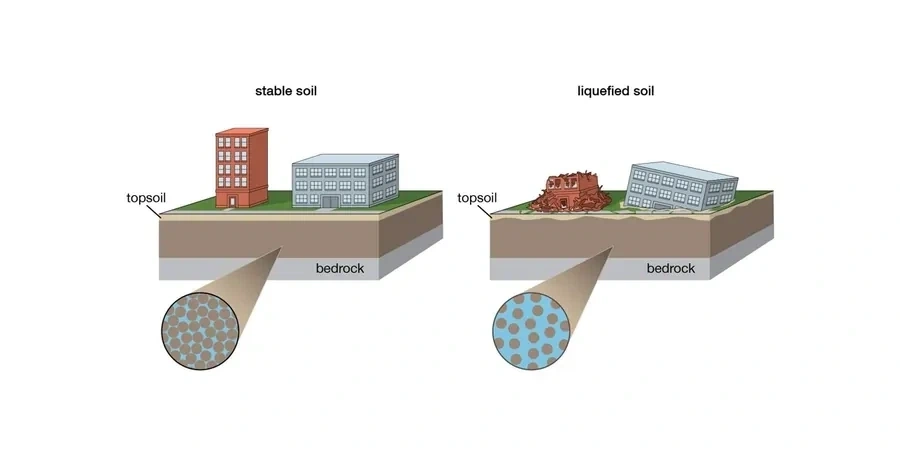
The coastal plain under Bognor Regis hides a quiet risk. Loose saturated sands and silts, common along this stretch of West Sussex coast, can lose strength rapidly under seismic or dynamic loading. That is liquefaction. And it can turn a straightforward foundation design into a costly failure. Our analysis quantifies this risk using site-specific data. For sites near Aldwick or Pagham, where the water table is high and the geology is complex, a desktop assessment alone is not enough. We correlate field data from CPT testing with laboratory cyclic triaxial to produce a factor of safety you can act on. No generic reports. No unnecessary ground treatment. Just a clear commercial decision tool for your Bognor Regis project.
Liquefaction in Bognor Regis is not about big earthquakes. It is about loose coastal sands, a high water table, and the right dynamic trigger. Know your factor of safety before you pour.
Quick answers
Is liquefaction really a risk in Bognor Regis, given the low UK seismicity?
Yes, it can be. The risk is not driven by large crustal faults. It is driven by the combination of loose saturated sands, a high water table, and any dynamic trigger. Even a moderate event in the English Channel, or heavy piling vibration on an adjacent site, can induce excess pore pressure. We have measured SPT N-values below 10 in sands under the coastal plain. That is prime liquefiable material.
What do I do if the analysis shows a liquefaction risk?
We define a clear path. If the LPI is low, we may recommend a stiffer foundation raft with edge beams to tolerate small settlements. If the risk is high, we specify Improvement. That could be vibrocompaction to densify the sand, or stone columns to provide drainage. The report gives your contractor a target depth and acceptance criteria. No open-ended remediation.
How long does a liquefaction analysis take?
A screening analysis on existing logs can be turned around in 5 working days. A full cyclic triaxial programme takes 4 to 6 weeks, including undisturbed sampling, laboratory testing, and reporting. We always align our schedule with your planning submission deadline.
What does a soil liquefaction analysis cost for a typical project in Bognor Regis?
For a screening-level LPI analysis using existing field data, budget between £1,790 and £2,350. A full programme with new SPT or CPT borings and cyclic triaxial testing typically ranges from £2,800 to £3,420, depending on depth and number of samples. This includes the AGS-format digital data and a stamped interpretative report.