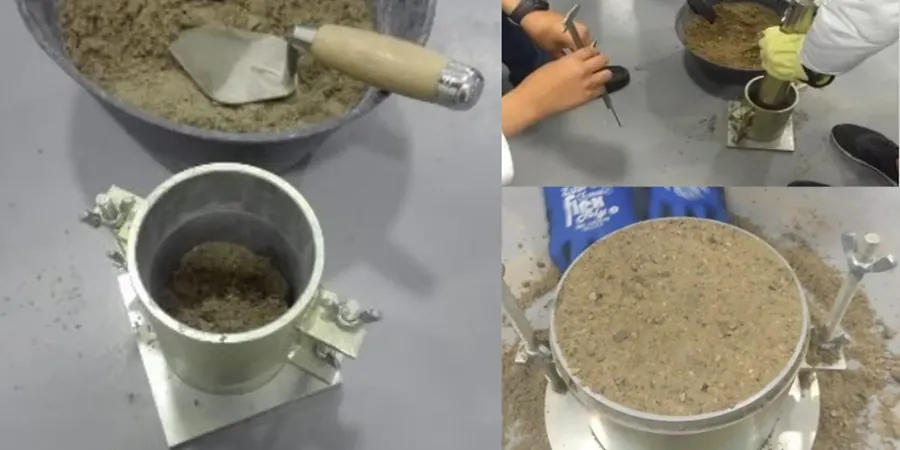
Bognor Regis sits on a coastal plain where the natural geology shifts from brickearth to marine deposits across short distances. Our lab has processed over 400 Proctor samples from the West Sussex corridor, and the pattern is clear: the moisture-density relationship here rarely matches textbook curves. That is why we insist on running a site-specific Proctor test before any fill placement begins. The town’s high water table, often less than 2 metres below ground in winter, means a contractor who skips compaction control can face differential settlement within the first rainy season. A sand cone density test paired with the lab Proctor gives the field verification that NHBC and local building control expect.
The difference between 95 % and 98 % relative compaction in Bognor’s silty sands can be the difference between a pavement that lasts ten years and one that fails in two.
Approach and scope
On the ground in Bognor, we see a lot of reworked London Clay and silty sands that behave beautifully at 12 % moisture but turn to slurry at 15 %. The Proctor test pinpoints that optimum window. We run both the 2.5 kg rammer method for finer grading and the 4.5 kg Modified Proctor where site traffic or heavy structures demand higher target densities. Every sample passes through our UKAS-accredited lab under BS 1377-4, and we report the maximum dry density and optimum moisture content with clear, readable curves — not just numbers. For chalk fill, which pops up around the South Downs edge near the town, we adjust the oversize correction so the result reflects what the roller actually sees on site. The service covers material classification, compaction specification recommendation, and end-product compliance — all tied back to the Method Specification or End-Product Specification your contract requires.
Site-specific factors
Eurocode 7 (BS EN 1997-2) treats fill as an engineered material, not just ‘dug and dumped’. In Bognor Regis, where the underlying geology can include soft alluvium from the Aldingbourne Rife catchment, poorly compacted fill acts as a perched water trap. We have pulled core samples from failed floor slabs where the fill underneath never exceeded 88 % relative compaction because the contractor relied on a borrowed Proctor curve from a site three miles away. The curve was wrong, the moisture was off, and the repair bill ran into six figures. Running the Proctor on the actual borrow material — and then checking it with nuclear gauge or sand cone — closes that gap. It is the cheapest insurance you can buy against an earthworks rejection.
Quick answers
How much does a Proctor test cost in Bognor Regis?
A Standard or Modified Proctor test typically runs between £80 and £180 per sample, depending on whether you need the full five-point curve and oversize correction. Volume pricing applies for three or more samples from the same site.
Do I need Standard or Modified Proctor for a house extension?
For a domestic extension with standard strip footings and a ground-bearing slab, the Standard Proctor (2.5 kg rammer) is usually sufficient. If the building inspector or structural engineer has specified a minimum relative compaction above 95 % for a heavily loaded slab, the Modified Proctor gives the more demanding reference density that matches modern compaction plant.
Can you test chalk fill from the South Downs?
Yes. Chalk breaks down during compaction, so we apply the oversize correction per BS 1377-4 and often recommend a chalk-specific moisture conditioning approach. We have tested chalk from several borrow pits around the Bognor-Chichester area and understand how it behaves differently from granular or clay fills.
How much sample material do you need?
We ask for at least 25 kg of remoulded material in a sealed bag or bucket. The sample must be representative of what you are placing on site — not just the fines, not just the lumps. If the fill is variable, multiple samples give a much more reliable picture.
How quickly can I get results?
Standard turnaround is three to five working days. We also offer a 24-hour express service when the roller is waiting and the weather window is closing — common enough in Bognor during the wetter months.