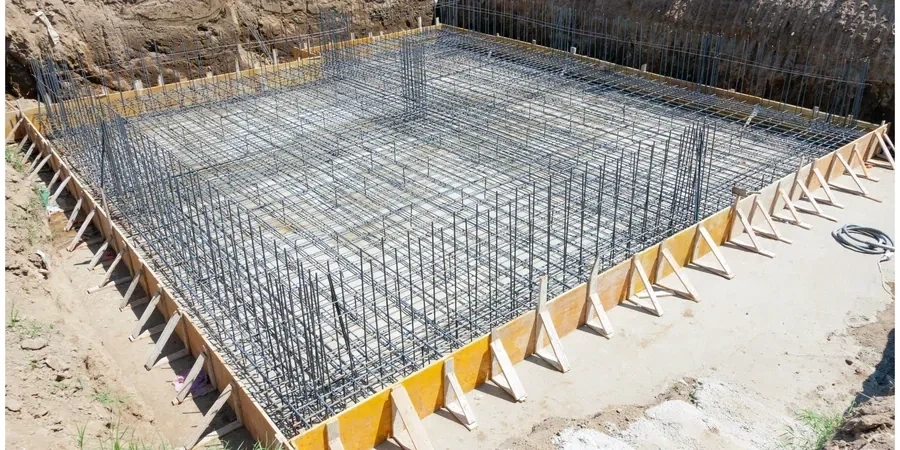
Bognor Regis sits just 5 metres above sea level on the West Sussex coastal plain, where the underlying geology shifts from Brickearth to soft alluvial clays across short distances. The town’s 63,000 residents know the ground here can be unpredictable. A test pit campaign often reveals the first surprises—layers of made ground over compressible silts that rule out conventional footings. Raft or mat foundation design becomes the logical path. We provide that design: a reinforced concrete slab spreading structural loads across a wide area, so differential settlement stays within tolerable limits. By integrating data from CPT testing and laboratory classification, we produce a foundation scheme that fits the site, not a generic template.
A raft foundation doesn't eliminate settlement—it controls it, turning differential movement into uniform tilt the structure can tolerate.
Common questions
When is a raft foundation better than deep piles in Bognor Regis?
When the competent bearing stratum is deeper than 3 metres but the soil above has enough stiffness to support a uniformly loaded slab. Rafts avoid the cost and vibration of piling rigs in tight residential streets, and they perform well on soft alluvial clays where total settlement can be managed by spreading the load.
What does a raft foundation design package typically cost?
For a standard residential project in Bognor Regis, the design fee ranges from £910 to £3,770, depending on footprint complexity, number of ground investigation points, and whether 3D finite element analysis is required.
How do you determine the subgrade reaction modulus for the raft design?
We avoid generic tables. The modulus is back-calculated from CPT cone resistance data or direct plate load tests on site. This gives a spring stiffness that reflects the actual layering beneath the Bognor Regis plot, not a regional average.
Can a raft foundation be designed on made ground?
Yes, provided the made ground is properly characterized. We often encounter old beach shingle or brick rubble fill in Bognor. If the fill is granular, well-compacted, and at least 2 metres thick, a stiffened raft can work. If it contains organic silts or uncompacted ash, we recommend excavation and replacement before raft construction.
What information do you need to start the raft design?
A topographic survey, the architectural ground-floor plan with column and wall loads, and the findings from a ground investigation—ideally one borehole or CPT per 150 m² of footprint, plus trial pits to inspect near-surface fill. We can scope the investigation if you haven't commissioned one yet.