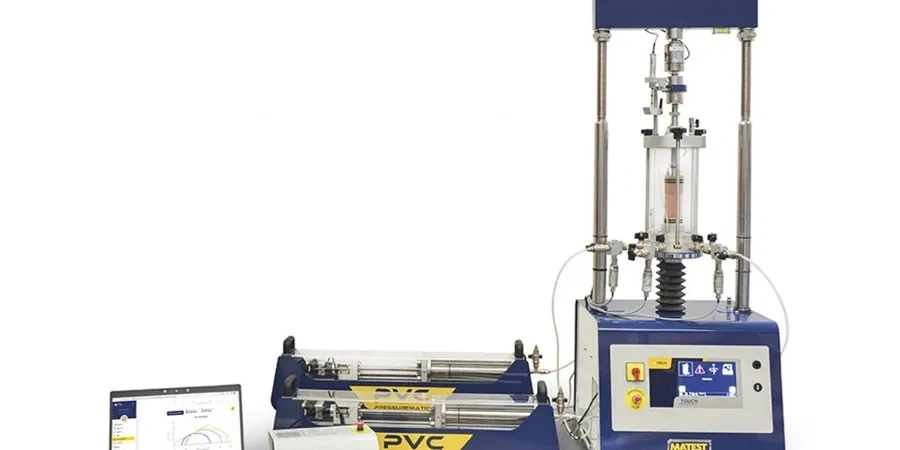
Too many ground investigations stop at the SPT. They get an N-value and walk away. Then the retaining wall goes in on Bognor Regis clay and the design assumptions fall apart. The London Clay formation here, with its fissured structure and variable silt content, demands better data. That’s where the triaxial test earns its place. We run consolidated undrained and drained triaxial tests to BS 1377-8 standards, giving your engineer real effective stress parameters—c' and phi'—not index-derived approximations. For coastal sites near Aldwick or Pagham where groundwater complicates everything, this test is non-negotiable. The lab processes samples within 48 hours of extraction, preserving natural moisture content. When you need shear strength parameters that hold up under scrutiny, we deliver data you can take to a Category 2 check without hesitation.
Effective stress parameters from a properly saturated triaxial test can reduce foundation over-design by 15 to 20 percent in Bognor Regis clay.
Approach and scope
A common sight in our lab: a sample from a Bognor Regis borehole arrives sealed in wax. We log the fissures immediately. The local geology here—bracklesham beds and London Clay—tends to produce samples that look intact but lose strength fast once remoulded. That’s why we saturate back-pressure slowly, matching in-situ stress history. We typically run three specimens per set at effective confining pressures of 100, 200, and 400 kPa for a 10-metre foundation depth, plotting Mohr circles that give you a failure envelope you can trust. The shearing stage runs at a rate of 0.017 mm/min for drained tests on this material—any faster and you build excess pore pressure that skews the results. Our technicians check cell pressure transducers and load cells against certified calibration rings weekly. The data package includes stress-strain curves, p-q plots, and axial strain at failure, all formatted for direct input into PLAXIS or Oasys.
Quick answers
What's the typical turnaround for a triaxial test set?
A standard set of three specimens, including saturation, consolidation, and shearing stages, takes 7 to 10 working days from sample receipt. Multi-stage tests or low-permeability clays may extend this by a few days. We provide interim plots as soon as each stage completes.
Do you need intact tube samples or can you test from bulk bags?
We need undisturbed samples—typically U100 tubes or pushed Shelby tubes. The triaxial test measures in-situ fabric and structure; remoulded material from a bulk bag won't give representative effective stress parameters. We can advise on sampling methods before your site investigation starts.
What's the cost range for a triaxial test in Bognor Regis?
A full triaxial test set of three specimens typically ranges from £1,300 to £2,260, depending on the test type (UU, CU, or CD) and specimen diameter. Multi-stage tests fall at the upper end. We quote firm prices after reviewing your soil description and depth range.
Which test type do I need—CU, CD, or UU?
For short-term stability of cuttings in Bognor Regis clay, consolidated undrained (CU) with pore pressure measurement is the right choice. For long-term settlement and drained conditions, you need a CD test. UU is a quick index for undrained strength but doesn't give effective stress parameters. We'll help you choose based on your design scenario.