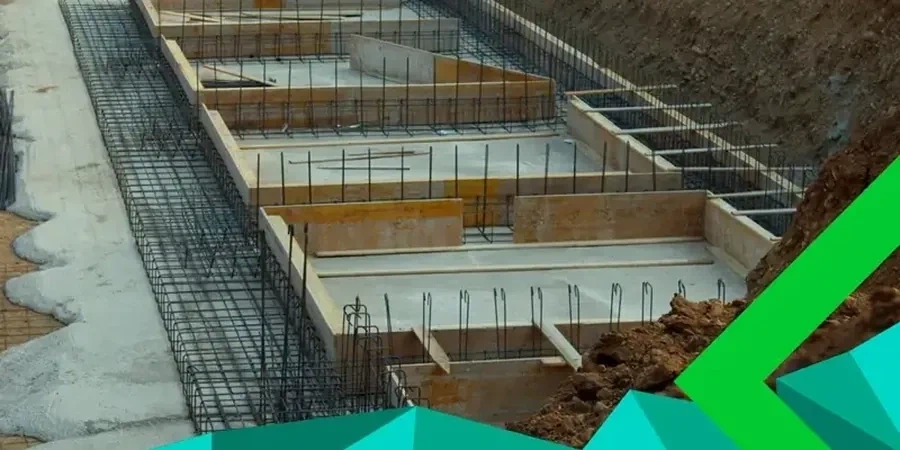
BS EN 1997-1:2004 (Eurocode 7) requires a ground investigation before any structure is placed on the earth, and in Bognor Regis this is not a box-ticking exercise. The town sits on a coastal plain where the Upper Chalk is capped by Pleistocene raised beach deposits and brickearth, and the water table often sits within 2 m of the surface. We see too many projects that assume a generic 150 kPa bearing capacity, only to find soft alluvium or loose sand at formation level. Our shallow foundation design work starts with the site's actual stratigraphy—whether that means a strip footing on the gravel terrace north of the A259 or a reinforced raft over the softer ground near the Aldingbourne Rife. For sites where the near-surface soils are marginal, we often pair the desk study with spt-drilling to log the transition into the chalk and confirm N-values, giving the structural engineer a defensible bearing pressure.
A shallow foundation on the Bognor Regis coastal plain is a conversation with the water table as much as with the soil.
Approach and scope
The ground beneath Bognor Regis changes quickly. A site on the well-drained gravels around North Bersted can carry 200 kPa on a simple pad footing, while a plot half a mile south, closer to the former marsh edge, may need a wider strip or a cellular raft to limit differential settlement to the 25 mm serviceability limit in BS 8004. The deciding factor is rarely the surface soil alone; it is the depth to chalk, the seasonal water table, and the risk of softening in the brickearth if the excavation is left open. We routinely specify a blinding layer within hours of final trim, and for sites where the chalk is deeper than 3 m we model the settlement trough using drained stiffness parameters from triaxial testing. In these cases, the
triaxial data gives us the effective stress envelope—c’ and φ’—so the bearing capacity calculation in Annex D of Eurocode 7 is anchored to measured values, not conservative assumptions. Where the client is considering a ground-bearing slab, we also review the CBR of the subgrade with a
cbr-road assessment to avoid over-excavation.
Site-specific factors
In Bognor Regis, we often see that the biggest risk to a shallow foundation is not the static load but the water that arrives after the trench is dug. The brickearth that overlies the gravel in many parts of town can stand up well in the dry, but a night of rain or a broken drain turns it into slurry. Once the formation softens, the allowable bearing pressure can halve, and the contractor faces unexpected mass-fill concrete just to reach competent ground. The other local hazard is dissolution features in the chalk—solution pipes filled with soft clay that can punch through an otherwise sound gravel layer. A pad footing spanning 1.2 m may be completely undermined if it straddles one of these features. Our approach is to specify at least two probe holes per footing location on larger projects, and to keep the foundation level above the zone of water table fluctuation where the structural form permits, reducing the long-term cyclic softening that erodes bearing capacity over decades.
Common questions
How deep do shallow foundations need to go in Bognor Regis to reach competent ground?
Depth varies block by block. On the gravel terraces north of the railway line, 0.9–1.2 m below ground level typically reaches dense gravel with N-values above 15. Closer to the seafront and along the Aldingbourne Rife corridor, soft alluvium can extend to 1.8–2.5 m, and we often specify trench-fill foundations to 2.1 m to bear onto the underlying gravel or chalk. A trial pit or borehole is the only way to confirm the depth on a specific plot.
What bearing capacity can I expect from the soil in Bognor Regis?
On the Pleistocene raised beach gravels, we have verified allowable bearing pressures of 200–250 kPa after applying the partial factors in Eurocode 7. On the brickearth, the value drops to 75–125 kPa depending on moisture content and plasticity. Sites within 200 m of the Rife can be lower still. We never quote a bearing capacity without a site-specific investigation because the transition between these units can be abrupt.
What is the typical cost for a shallow foundation design package in Bognor Regis?
For a straightforward residential project—say a single-storey extension or a detached house—our design package including the ground investigation specification, bearing capacity analysis, and settlement check typically falls between £1,300 and £2,820, depending on the number of foundation elements and the complexity of the ground profile. A commercial raft foundation on marginal ground sits at the upper end of that range.
Is a ground investigation mandatory for a small extension in Bognor Regis?
Building Control will expect a ground investigation under Approved Document A and BS EN 1997-1. Even for a single-storey rear extension, we recommend at least one trial pit or window sample borehole. The cost of the investigation is dwarfed by the extra concrete, rebar, and delay that follow from guessing the ground and getting it wrong—especially given the variability of the brickearth and the shallow water table in this coastal town.