← Home · Geophysics

MASW Survey and VS30 Site Classification in Bognor Regis

Together, we solve the challenges of tomorrow.

SEE MORE →

The ground beneath a building site in Aldwick behaves quite differently from what you will find up around North Bersted, and that contrast is not always obvious from a simple borehole log. Along the coastal plain of Bognor Regis, the transition from raised beach deposits of the Goodwood-Slindon formation to the softer Bracklesham Beds can shift within a hundred metres, altering the dynamic stiffness of the soil profile in ways that matter for seismic design. A MASW survey lets us map the shear wave velocity profile continuously, giving engineers the VS30 value they need to classify the site per Eurocode 8 without relying on proxy correlations alone. In our experience, combining this surface-wave method with a targeted SPT drilling programme gives the most defensible ground model for foundations in the town's variable Quaternary geology.

A site's VS30 value can shift the design spectral acceleration by over 30% compared with default ground type assumptions — measuring it directly changes the structural cost equation.

Approach and scope

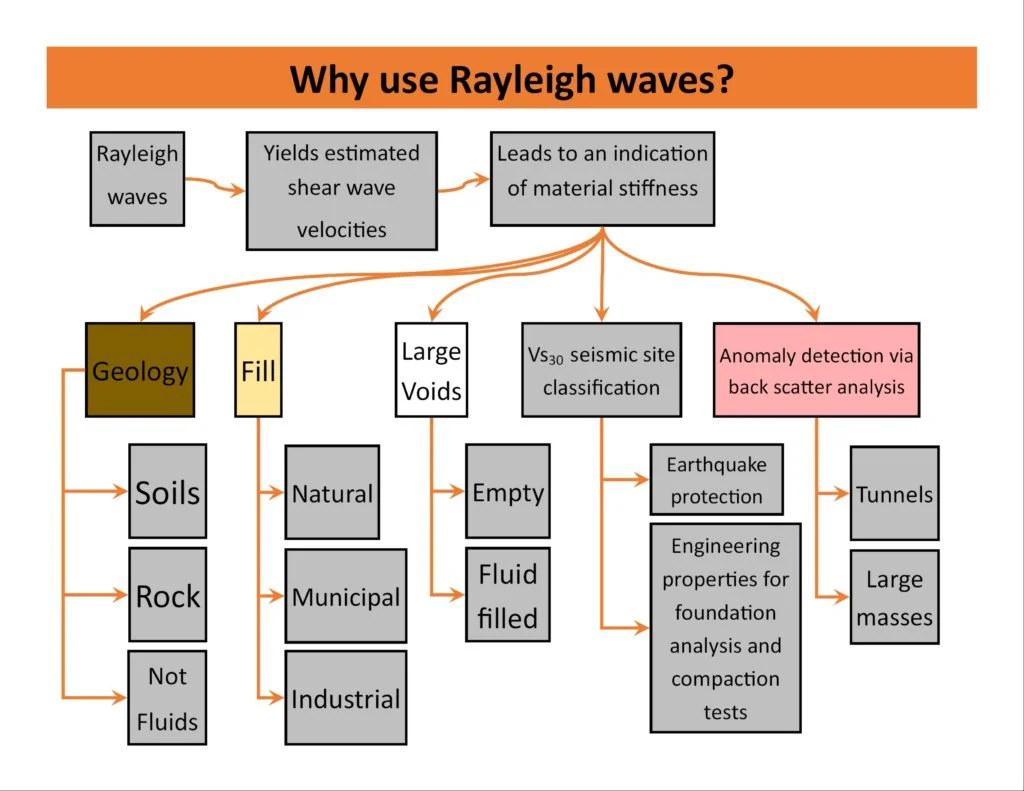
BS EN 1997-2:2007 places clear emphasis on deriving ground stiffness parameters from direct measurement rather than tabulated values, and for good reason in a town like Bognor Regis where the thickness of the soft alluvial cover changes dramatically between the seafront and the Chichester Road corridor. The MASW technique records the dispersion of Rayleigh waves generated by a controlled seismic source, processing the data through a two-dimensional velocity spectrum to extract the fundamental-mode dispersion curve. From that curve, an iterative inversion algorithm reconstructs a one-dimensional shear wave velocity profile at the test location. The key deliverable is the time-averaged VS30, which classifies the site into ground type B, C, D or E under BS EN 1998-1, directly influencing the elastic response spectrum used in structural analysis. Where the water table sits within the upper three metres — a common condition across the Pagham Harbour catchment — the method remains largely unaffected by saturation, unlike some electrical techniques, though we often pair it with a seismic refraction line when the client needs a high-resolution tomogram of the top ten metres for shallow footing design.
MASW Survey and VS30 Site Classification in Bognor Regis
Technical reference image — Bognor Regis

Site-specific factors

The superficial geology across the Bognor Regis district is dominated by Quaternary brickearth and marine sands that can exhibit liquefaction susceptibility under long-duration seismic loading — the British Geological Survey maps show extensive stretches of the Selsey Sand and Pagham Formation directly overlying the London Clay at depths of 8 to 15 metres. When we encounter these sequences, the shear wave velocity profile often reveals a marked impedance contrast at the clay interface that concentrates shear strain during an earthquake. A site assumed to be Ground Type C based on SPT N-values alone might actually plot as Type D once the VS30 is measured, triggering a higher design ground acceleration and more stringent foundation requirements. Developers working on multi-storey residential blocks near the regeneration corridor find that early MASW data helps avoid costly redesign loops when the structural engineer has already locked in assumptions that the ground investigation contractor cannot substantiate.

Need a geotechnical assessment?

Reply within 24h.

Email: contact@geotechnical-engineering1.com

Technical parameters


ParameterTypical value
Measured parameterShear wave velocity (Vs) vs. depth
Standard outputVS30 (time-averaged Vs to 30 m)
Depth of investigationTypically 30–40 m, expandable to 60 m
Seismic sourceAccelerated weight drop or sledgehammer
Receiver array24–48 channel vertical geophone spread
Site classificationBS EN 1998-1 Ground Types B through E
Data processing standardASTM D4428 / D7400 compatible workflow
Reporting formatDispersion curves, Vs profile, VS30 map, AGS data file

Related technical services

01

Single-location VS30 profiling

A single MASW spread deployed at the building footprint to determine the VS30 value and site class for Part A structural design submissions.

02

Multi-line 2D shear wave sections

Parallel and orthogonal MASW lines across larger sites, producing contoured cross-sections of shear wave velocity that highlight lateral variability in the brickearth and gravel lenses.

03

Seismic microzonation support

Grid-based MASW acquisition for site-wide seismic classification, delivering VS30 contour maps used in masterplanning and foundation strategy reports.

04

Combined geophysical and intrusive package

MASW integrated with SPT boreholes, CPT soundings and laboratory dynamic testing to calibrate the velocity model and satisfy BS EN 1997-2 requirements for derived values.

Relevant standards


BS EN 1997-2:2007 (Eurocode 7 – Ground investigation and testing), BS EN 1998-1:2004+A1:2013 (Eurocode 8 – Seismic actions, including site classification by VS30), BS 5930:2015+A1:2020 (Code of practice for ground investigations), ASTM D4428 / D7400 (Crosshole and surface-wave seismic testing – reference standard for processing)

Common questions

How much does a MASW survey cost for a residential plot in Bognor Regis?

For a single-family residential plot requiring one or two MASW spreads, the cost typically falls between £1.330 and £2.330, depending on the number of array positions, the required depth of investigation, and site access conditions. We provide a fixed-price proposal after reviewing the location and the structural engineer’s requirements.

Does Bognor Regis really need a seismic site classification?

While the UK is a low-to-moderate seismicity region, BS EN 1998-1 still applies to structures in consequence classes CC2 and CC3, and the local ground conditions — particularly the soft brickearth and saturated sands of the coastal plain — can amplify ground motion significantly. A measured VS30 avoids conservative default assumptions that add unnecessary cost to the foundation design.

How does MASW compare with a downhole seismic test?

MASW is non-intrusive and tests a larger volume of ground laterally, giving a more representative average VS30, whereas a downhole test measures velocity directly at the borehole wall and requires a cased hole in good condition. In Bognor Regis soils, where the London Clay surface can be weathered and irregular, the surface-wave approach often produces a cleaner dispersion curve with less near-field disturbance.

What depth can a MASW survey reach on the West Sussex coastal plain?

With a 48-channel spread and a 4.5-metre geophone spacing, we routinely achieve reliable shear wave velocity profiles to 35–40 metres depth. The soft alluvial cover overlying the London Clay in the Bognor Regis area provides good Rayleigh wave propagation, and we can extend the investigation to 60 metres by increasing the source offset and array aperture.

How long does it take to get the VS30 report after the field survey?

Field acquisition for a standard two-line MASW survey is typically completed in one day. Processing, inversion modelling, and reporting take five to seven working days, and we can fast-track the preliminary VS30 value within 48 hours if the design team needs the site class urgently for a submission deadline.
Location and service area

We serve projects across Bognor Regis and its metropolitan area.

View larger map